
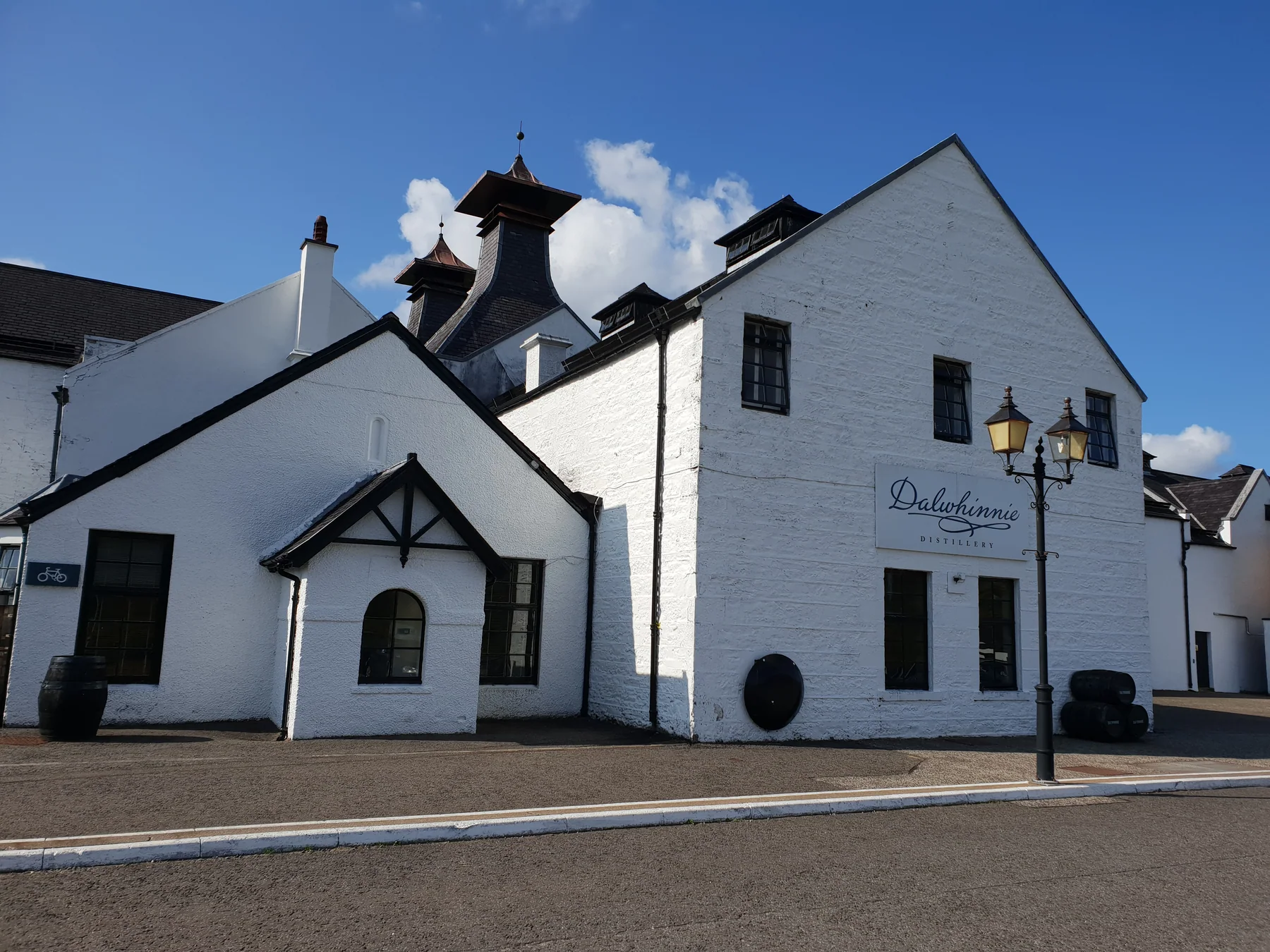
About Dalwhinnie Distillery
Dalwhinnie Distillery stands at about 355 metres above sea level in the village of Dalwhinnie, within the mountain landscape now enclosed by Cairngorms National Park. The A9, Highland railway and old military-road corridor explain why a distillery was established in this exposed location: it was remote in character but connected to north-south transport.
The site is normally presented as a Highland distillery, and its owner markets the whisky as Highland single malt. Some regulatory and administrative descriptions place Dalwhinnie within the defined Speyside area, so “Highland” here describes the established identity and physical setting rather than denying the overlap at the region’s south-western edge.
History
John Grant of Grantown-on-Spey, George Sellar of Kingussie and designer Alexander Mackenzie established the original Strathspey Distillery in 1897. Production began in 1898, but the first company quickly entered liquidation. A. P. Blyth acquired the plant and renamed it Dalwhinnie, separating the short-lived founding venture from the continuing distillery name.
The distillery changed owners several times in its first decades. American firm Cook & Bernheimer bought it in 1905 and used Dalwhinnie in whisky prepared for the United States market. Prohibition ended that chapter, after which Macdonald Greenlees returned the operation to Scottish ownership in 1919.
Macdonald Greenlees became part of the Distillers Company in 1926, and Dalwhinnie was licensed to James Buchanan & Co. A fire in 1934 forced a closure lasting several years before production resumed. These interruptions matter because a simple “making whisky since 1897” phrase can conceal both the failed Strathspey company and the later reconstruction.
Dalwhinnie subsequently became part of the portfolio now owned by Diageo and was included in the Classic Malts selection introduced during the late twentieth century. That programme helped present the individual single malt more visibly, alongside its continuing value within blended Scotch.
What makes it distinctive
Production water comes from the Allt an t-Sluic, flowing from the surrounding uplands. The official account draws attention to the elevated source and the cold local environment, but altitude should not be treated as a complete explanation of flavour. Fermentation, distillation, condensation and cask selection remain more direct production influences.
Dalwhinnie uses copper pot stills and traditional worm-tub condensers, in which coiled copper pipes are cooled in external water tanks. Worm tubs generally provide less copper interaction than modern shell-and-tube condensers and are an important part of understanding the weight and texture of the spirit.
The distillery’s official style references heather honey, gentle smoke and a dry finish. Peat influence is measured rather than dominant, distinguishing Dalwhinnie from heavily peated island malts while still giving the spirit more structure than a purely light or floral description suggests.
Whisky character and significance
Dalwhinnie 15 Year Old is the best-known expression and helped define the distillery’s public identity through the Classic Malts programme. Other releases demonstrate different cask treatments and ages, but the stable point is the combination of honeyed sweetness, restrained smoke and the weight associated with worm-tub condensation.
The distillery is historically useful because its fortunes followed transport, international ownership, Prohibition, fire and corporate consolidation. Its story is therefore broader than the familiar image of white buildings beneath Highland mountains.
Visiting Dalwhinnie Distillery
Guided visits and tastings operate from the visitor centre, with chocolate pairings appearing in the distillery’s established presentation. Current experiences should be confirmed directly, and winter travel deserves particular care because road and weather conditions can change quickly at this elevation.
Location and surrounding area
Dalwhinnie lies between Perth and Inverness beside both the A9 and the Highland railway. The village can fit naturally into a journey through Badenoch, but it should not be reduced to a hurried roadside stop. Loch Ericht, the Drumochter Pass and the wider Cairngorms landscape explain the strategic and environmental setting in which the distillery developed.
- Whisky region
- Highlands
- Location
- General Wade's Military Road, Dalwhinnie, PH19 1AA
- Visitor information
- Check the official website for current tours, tastings, access and booking arrangements.
Further information
Visit the official Dalwhinnie Distillery website
Dalwhinnie: official visitor information