
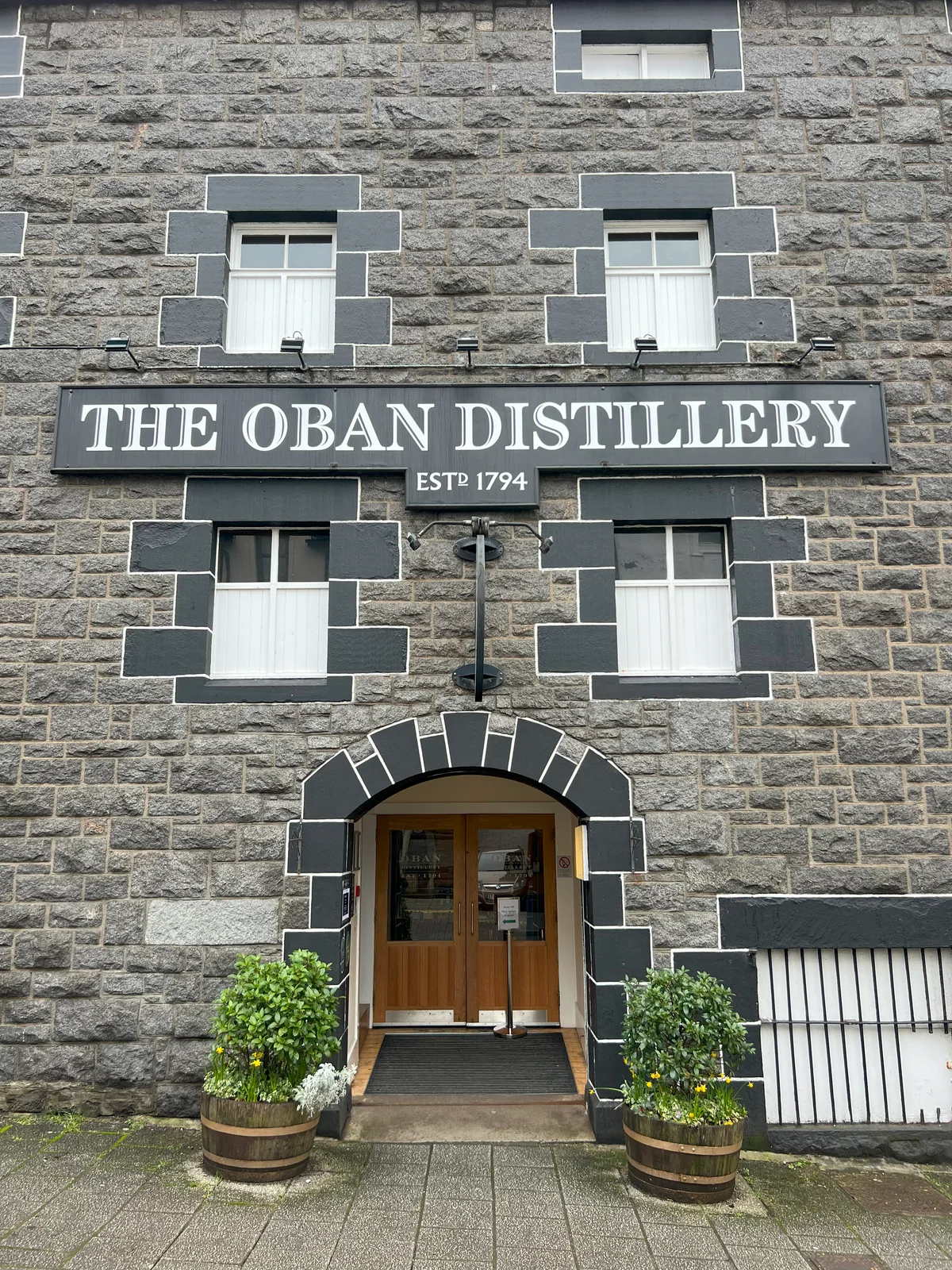
About Oban Distillery
Oban Distillery is embedded in the centre of the west-coast town, between the harbour and the steep ground behind Stafford Street. Hugh and John Stevenson established a brewery business in 1793, and the distillery conventionally uses 1794 as its foundation year. Heritage records place a clearly documented distilling business on the site by 1799, so the dates describe the development from brewery venture to licensed spirit production rather than a simple contradiction.
The distillery's compact footprint is a consequence of the town growing around it. Oban therefore offers a different relationship between place and production from a remote estate: nineteenth-century warehouses, streets, houses and later civic development enclosed a site that could not expand freely outward.
History
The Stevenson brothers were merchants and entrepreneurs involved in the planned growth of Oban as a fishing, trading and manufacturing settlement. Their brewing and distilling business formed part of that wider programme. The Stevenson connection continued into the nineteenth century, although exact transfer dates vary in secondary accounts because management, family ownership and sale were not necessarily the same event.
Historic Environment Scotland records A. & R. Walker taking over around 1861 and local merchant Peter Cumstie buying the operation in 1866. J. Walter Higgin acquired it in 1883 and substantially rebuilt the distillery. Warehouse and office work followed in the 1890s, with architect George Woulfe Brenan and later Charles C. Doig contributing to the complex that remains prominent on Stafford Street.
Oban became part of the Distillers Company through the twentieth-century consolidation of Scotch whisky businesses and is now owned by Diageo. Production stopped during parts of both world wars and again during a major early-1970s rebuilding, when the stillhouse was renewed. The distillery joined the Classic Malts selection in 1988, increasing the visibility of its 14-year-old single malt while spirit continued to serve blending requirements.
What makes it distinctive
Oban operates with one wash still and one spirit still, both relatively small and lamp-glass shaped. Vapours condense in traditional wooden worm tubs positioned among the rooftops behind the distillery. This low-copper condensation helps retain body and sulphury or waxy precursors that maturation can transform into a substantial, textured whisky.
Malted barley arrives from outside the constrained town-centre site, while production water is brought from a loch in the hills behind Oban. Long fermentation in wooden washbacks encourages fruit before slow distillation. These details explain how a small physical plant maintains a recognisable make without relying on vague claims that harbour air alone creates flavour.
Much of the range matures first in refill American oak, allowing orange, malt and gentle smoke to remain visible. The Distillers Edition has historically used a Montilla Fino cask finish, while other releases can follow different wood policies. Maturation details therefore need to be read expression by expression rather than applied universally.
Whisky character and significance
Oban's house character is commonly described through orange, malt, honey, gentle spice, wax and restrained smoke, with a dry or lightly saline finish. Its position between mainland and island ferry routes has encouraged the convenient phrase 'gateway' style, but production equipment and maturation offer a firmer explanation than geographical metaphor alone.
The distillery is also historically useful because it predates much of modern Oban. Its survival within the town records the relationship between early industrial enterprise, harbour growth and later tourism. The compact scale should not be mistaken for an unchanged eighteenth-century plant: rebuilds, corporate ownership and renewed equipment all form part of the present operation.
Visiting Oban Distillery
Guided experiences operate from the Stafford Street visitor centre and can interpret production within a very tight working site. Current access, tastings and tour routes should be confirmed directly. Stairs and historic industrial spaces may affect accessibility, and production demands can limit what is open.
Location and surrounding area
The harbour, ferry terminal, railway, McCaig's Tower and seafront are all within walking distance. Oban is a practical base for Argyll and island journeys, but ferry traffic and busy summer roads affect schedules. The distillery works best as part of the town's history rather than as an isolated stop disconnected from the port around it.
- Whisky region
- Highlands
- Location
- Oban, Argyll, PA34 5NH
- Visitor information
- Check the official website for current tours, tastings, access and booking arrangements.
Further information
Visit the official Oban Distillery website
Oban: official visitor and production context